HydrOptics.jl Documentation
Overview
HydrOptics.jl calculates the downwelling irradiance field in the upper ocean. It uses the Monte Carlo method to simulate the trajectories of photons, from their refraction at the air–water interface to specific depths beneath the surface [1] [2].
Optical oceanography concerns all aspects of light and its interaction with seawater, which are crucial for addressing problems related to physical, biological, and chemical oceanographic processes, such as phytoplankton photosynthesis, biogeochemical cycles, and climate change [3] [4]. However, due to the complex interaction between light and free-surface wave geometry, the irradiance distribution can be highly variable [5] [6], making it difficult to obtain analytical solutions. HydrOptics.jl enables physics-based, reproducible simulations of light distribution beneath the ocean surface.
HydrOptics.jl implements a Monte Carlo ray-tracing algorithm, whose accuracy depends on the number of simulated photon paths. This approach yields not only averaged quantities, such as mean intensity and flux, but also detailed three-dimensional distributions of irradiance. Combined with its built-in light refraction calculator, HydrOptics.jl is a standalone tool specifically designed for modeling irradiance fields modulated by complex ocean surface geometries. For more general applications that require only averaged radiative quantities, deterministic solvers of the radiative transfer equation (RTE) are available, such as PythonicDISORT [7] and DISORT [8]. For time-dependent problems, the open-source package OceanBioME.jl [9] includes a model of biomass-induced light attenuation that estimates the photon flux available at specific depths using a plane-parallel approximation.
Quick Install
Launch Julia and type
using Pkg
Pkg.add("HydrOptics")
After installing, verify that HydrOptics works as intended by:
Pkg.test("HydrOptics")Running your first model
As a simple example, let’s calculate the downwelling irradiance field when the surface is completely flat and a total of 10,000,000 photons are focused at a single point in the center.
using HydrOptics
using Random

# irradiance
nz = 200                    # Number of total grid point in z direction
dz = 1                      # Physical length of grid spacing in z direction
nxe = 512                   # Number of grid point of the calculation grid in x direction
nye = 512                   # Number of grid point of the calculation grid in y direction
num = 31                    # Constant value (number of angle measurement in Kirk,1981)
ztop = 10                   # Number of grid point in air phase in z direction
# photon
nphoton = 10000000          # Number of photons being generated at each grid point
kr = 10                     # Dummy variable (in developement, not being used)
nxp = 512                   # Number of grid points in x direction where photon can be emitted
kbc = 0                     # Binary value 0 and 1 depending on Boundary condition being implemented
b = 0.0031                  # Scattering coefficient
nyp = 512                   # Number of grid points in x direction where photon can be emitted
a = 0.0196                  # Absorbtance coefficient
# wave
pey = 2*pi/20.0             # Lowest wavenumber that can be captured during the derivative of surface elevation in x direction
nxeta = 512                 # Number of surface elevation grid point in x direction
nyeta = 512                 # Number of surface elevation grid point in y direction
pex = 2*pi/20.0             # Lowest wavenumber that can be captured during the derivative of surface elevation in y direction

data=Dict("irradiance"=>Dict("nxe"=>nxe,"nye"=>nye,"nz"=>nz,"dz"=>dz,"ztop"=>ztop,"num"=>num),
            "wave"=>Dict("pex"=>pex,"pey"=>pey,"nxeta"=>nxeta,"nyeta"=>nyeta),
            "photon"=>Dict("nxp"=>nxp,"nyp"=>nyp,"nphoton"=>nphoton,"a"=>a,"b"=>b,"kr"=>kr,"kbc"=>kbc))

HydrOptics.writeparams(data)
p = HydrOptics.readparams()

η = zeros(p.nxs,p.nys)
ηx = zeros(p.nxs,p.nys)
ηy = zeros(p.nxs,p.nys)
xpb = zeros(p.nxp,p.nyp);
ypb = zeros(p.nxp,p.nyp);
zpb = zeros(p.nxp,p.nyp);
θ = zeros(p.nxp,p.nyp);
ϕ = zeros(p.nxp,p.nyp);
fres = zeros(p.nxp,p.nyp);
ed = zeros(p.nx, p.ny, p.nz)
esol = zeros(p.num, p.nz)
randrng = MersenneTwister(1234)
area = zeros(4)
interi = zeros(Int64,4)
interj = zeros(Int64,4)
ix = div(p.nxη,2)+1
iy = div(p.nyη,2)+1
ϕps,θps = HydrOptics.phasePetzold()

HydrOptics.interface!(xpb,ypb,zpb,θ,ϕ,fres,η,ηx,ηy,p)
for ip = 1:p.nphoton
    HydrOptics.transfer!(ed,esol,θ[ix,iy],ϕ[ix,iy],fres[ix,iy],ip,xpb[ix,iy],
        ypb[ix,iy],zpb[ix,iy],area,interi,interj,randrng,η,ϕps,θps,p,1)
end
HydrOptics.applybc!(ed,p)

max_val, max_loc = findmax(ed)
ed = ed./max_val
nonzero_vals = ed[ed .!= 0]
min_val = minimum(nonzero_vals)

for i in 1:Int(nxe+1)
    for j in 1:Int(nye+1)
        for k in ztop:nz
            if ed[i,j,k] == 0
                ed[i,j,k] = min_val
            end
        end
    end
end
We can then visualise this with,
using Pkg; Pkg.add("Plots")

using Plots
using Plots.Measures

# Choose slice indices
iy_c = 256   # y-index for vertical cross-section
iz_a = 40    # z-index for panel (a)
iz_b = 160   # z-index for panel (b)

# Define layout: 2 rows, 2 columns, but right column spans both rows
l = @layout [grid(2,1) c]

# Panel (a) : z = iz_a
p1 = heatmap(
    p.x .-10, p.y .-10, log.(ed[:,:,iz_a]),
    clim=(-20,-7), framestyle=:box, grid=false,
    c=cgrad(:viridis), legend=:none,
    xlabel="\$x(m)\$", ylabel="\$y(m)\$",
    title="(a) z = $(round(p.z[iz_a], digits=1)) m",
    xlim=[minimum(p.x).-10, maximum(p.x).-10],
    ylim=[minimum(p.y).-10, maximum(p.y).-10])
plot!(p1, [minimum(p.x).-10, maximum(p.x).-10], [p.y[iy_c]-10, p.y[iy_c]-10],
      color=:red, lw=2, ls=:dash, alpha=0.6)

# Panel (b) : z = iz_b
p2 = heatmap(
    p.x .-10, p.y .-10, log.(ed[:,:,iz_b]),
    clim=(-20,-7), framestyle=:box, grid=false,
    c=cgrad(:viridis), legend=:none,
    xlabel="\$x(m)\$", ylabel="\$y(m)\$",
    title="(b) z = $(round(p.z[iz_b], digits=1)) m",
    xlim=[minimum(p.x).-10, maximum(p.x).-10],
    ylim=[minimum(p.y).-10, maximum(p.y).-10])
plot!(p2, [minimum(p.x).-10, maximum(p.x).-10], [p.y[iy_c]-10, p.y[iy_c]-10],
      color=:red, lw=2, ls=:dash, alpha=0.6)

# Panel (c) : vertical cross-section at y = iy_c
p3 = heatmap(
    p.x .-10, reverse(p.z), reverse(transpose(log.(ed[:,iy_c,:]))),
    clim=(-20,-7), framestyle=:box, grid=false,
    c=cgrad(:viridis), ylim=(-(nz*dz-10),0),
    xlabel="\$x(m)\$", ylabel="\$z(m)\$",
    cbar_title="\$\\ln\\frac{I(x,y,z)}{I_{0}}\$",
    title="(c) y = $(round(p.y[iy_c]-10, digits=1)) m",
    xlim=[minimum(p.x).-10, maximum(p.x).-10])

# Add horizontal lines for z = iz_a, iz_b
plot!(p3, [minimum(p.x).-10, maximum(p.x).-10], [p.z[iz_a], p.z[iz_a]],
      color=:red, lw=1.5, ls=:dash, label="", alpha=0.6)
plot!(p3, [minimum(p.x).-10, maximum(p.x).-10], [p.z[iz_b], p.z[iz_b]],
      color=:red, lw=1.5, ls=:dash, label="", alpha=0.6)

# Combine
plot(p1, p2, p3, layout=l,
     size=(900,700),
     titleloc=:left, titlefont=font(8),
     left_margin=10mm, right_margin=10mm)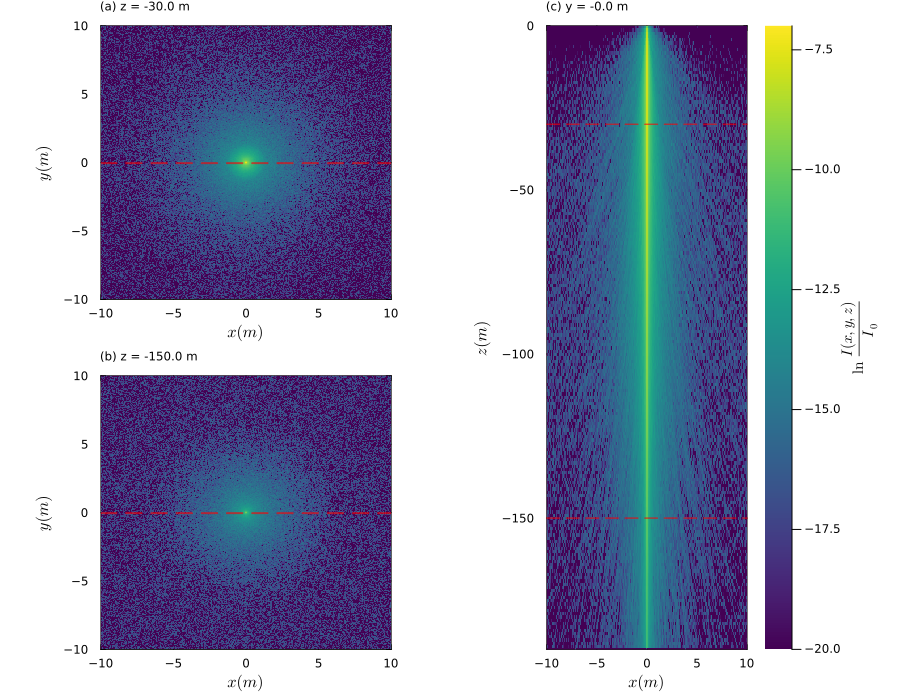
For a complete guide with details on each function and step, see the HydrOptics's Documentation.
Gallery
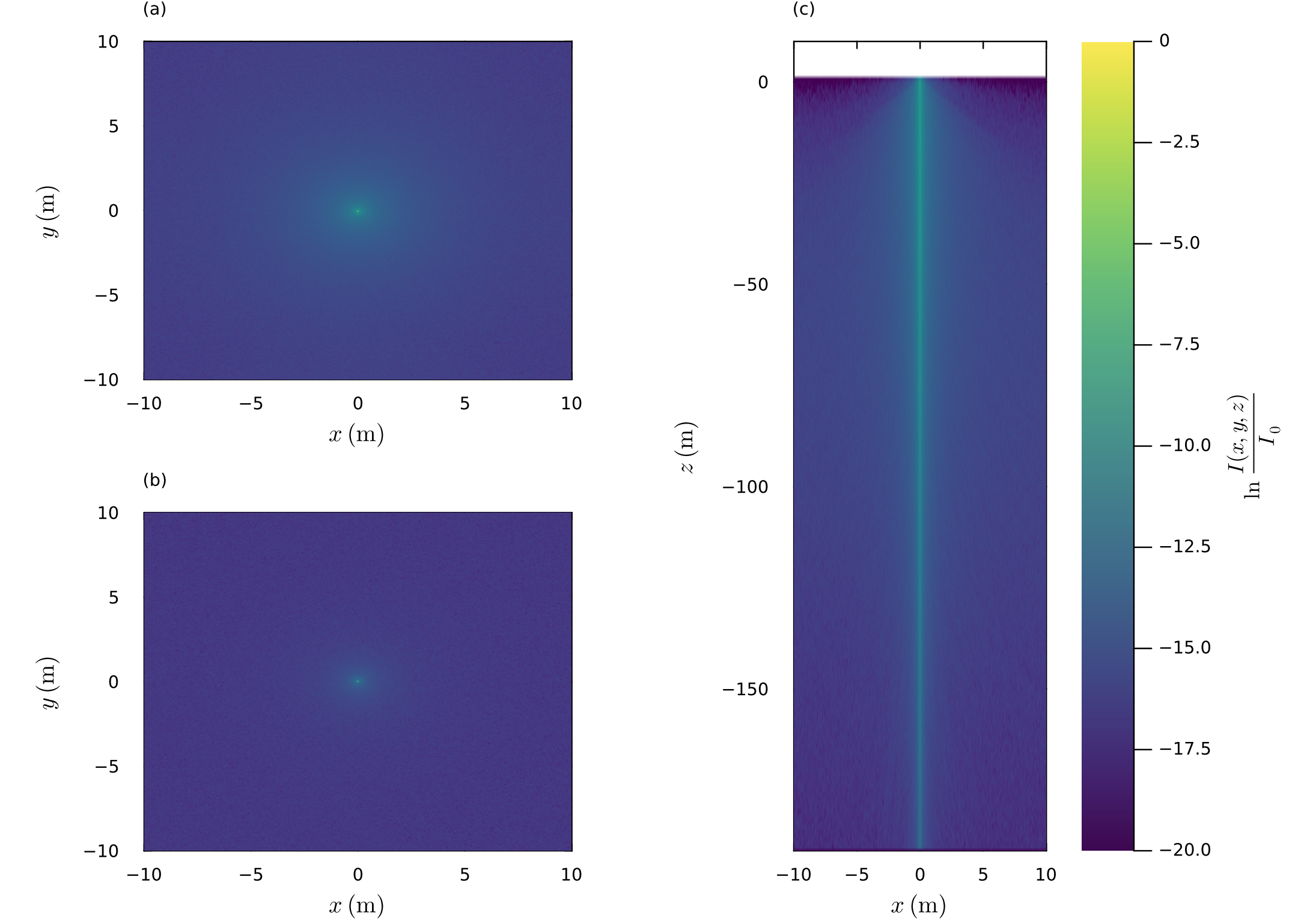
Simulation of $10^{8}$ Photons at the center of the flat surface. (a) irradiance field on the horizontal plane at $30\ \mathrm{m}$ depth. (b) irradiance field on the horizontal plane at $150\ \mathrm{m}$ depth. (c) irradiance field on the vertical plane at the center
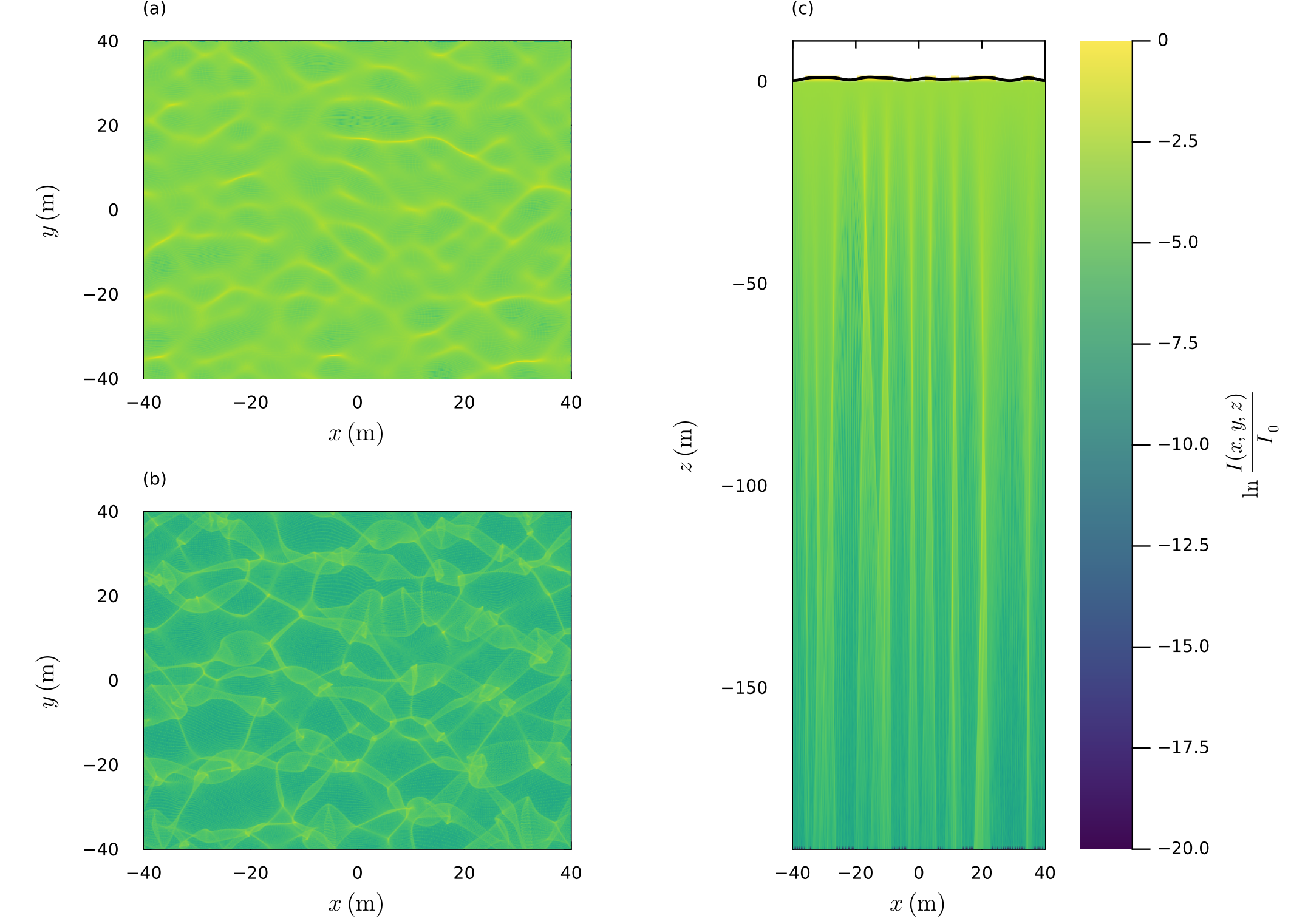
Simulation of 1000 Photons at the every grid point with observed surface elevation. (a) irradiance field on the horizontal plane at $30\ \mathrm{m}$ depth. (b) irradiance field on the horizontal plane at $150\ \mathrm{m}$ depth. (c) irradiance field on the vertical plane at the center.
Reference
- 1Hao, X., & Shen, L. (2022). A novel machine learning method for accelerated modeling of the downwelling irradiance field in the upper ocean. Geophysical Research Letters, 49, e2022GL097769. https://doi.org/10.1029/2022GL097769
- 2Kirk, J. T. O. (1981). Monte Carlo procedure for simulating the penetration of light into natural waters. In Technical paper - Commonwealth Scientific and Industrial Research Organization (Vol. 36).
- 3Dickey, T. D., Kattawar, G. W., & Voss, K. J. (2011). Shedding new light on light in the ocean. Physics Today, 64(4), 44-49. https://doi.org/10.1063/1.3580492
- 4Dickey, T., Lewis, M., & Chang, G. (2006). Optical oceanography: recent advances and future directions using global remote sensing and in situ observations. Reviews of geophysics, 44(1). https://doi.org/10.1029/2003RG000148
- 5Darecki, M., Stramski, D., & Sokólski, M. (2011). Measurements of high‐frequency light fluctuations induced by sea surface waves with an Underwater Porcupine Radiometer System. Journal of Geophysical Research: Oceans, 116(C7). https://doi.org/10.1029/2011JC007338
- 6Gernez, P., Stramski, D., & Darecki, M. (2011). Vertical changes in the probability distribution of downward irradiance within the near‐surface ocean under sunny conditions. Journal of Geophysical Research: Oceans, 116(C7). https://doi.org/10.1029/2011JC007156
- 7Ho, D. J., (2024). PythonicDISORT: A Python reimplementation of the Discrete Ordinate Radiative Transfer package DISORT. Journal of Open Source Software, 9(103), 6442, https://doi.org/10.21105/joss.06442
- 8Stamnes, K., Tsay, S. C., Wiscombe, W., & Jayaweera, K. (1988). Numerically stable algorithm for discrete-ordinate-method radiative transfer in multiple scattering and emitting layered media. Applied optics, 27(12), 2502-2509. https://doi.org/10.1364/AO.27.002502
- 9Strong-Wright et al., (2023). OceanBioME.jl: A flexible environment for modelling the coupled interactions between ocean biogeochemistry and physics. Journal of Open Source Software, 8(90), 5669, https://doi.org/10.21105/joss.05669